
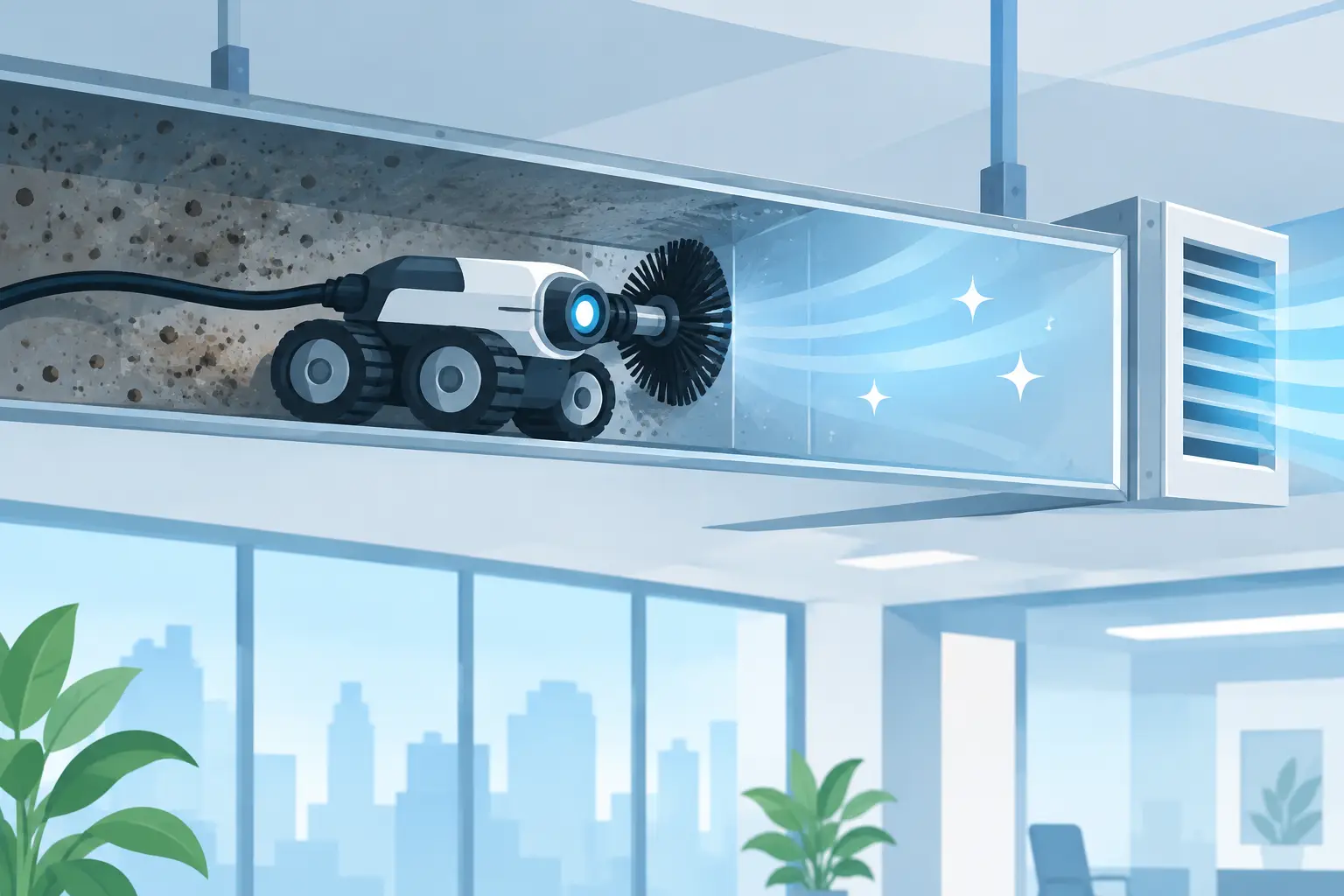
A ceiling diffuser may look clean while the ductwork above it tells a different story. Dust, loose debris and residues can gradually settle inside supply and return air ducts, particularly in busy commercial buildings where air conditioning operates for long hours. Robotic air duct cleaning gives facility teams a practical way to inspect these concealed areas and clean them with clear visual evidence rather than guesswork.
For building owners, property managers and maintenance teams, the objective is not simply to make ducts look cleaner. It is to understand the actual condition of the air distribution system, address relevant contamination, and make informed decisions about ongoing HVAC maintenance.
Why duct condition deserves attention
Ductwork is largely out of sight, but it is part of the route through which conditioned air is delivered to offices, retail areas, classrooms, production spaces and shared facilities. When dust accumulates within ducts, it can be disturbed by air movement and recirculated through the system. The effect on a building depends on the type and amount of material present, airflow conditions, filter performance, occupancy and the maintenance history of the air handling equipment.
A dirty duct is not always the cause of every indoor comfort or air quality complaint. Stuffy rooms, uneven temperatures, odours and visible dust can also be linked to clogged filters, moisture problems, poor outside-air supply, coil contamination, incorrect fan settings or inadequate airflow balancing. That is why inspection matters. It helps separate a confirmed duct cleanliness issue from an assumption.
For commercial and industrial premises, duct cleaning is often considered after renovation work, a period of heavy dust exposure, water ingress, pest activity, a change in building use, or an indoor air quality concern. It may also form part of a planned maintenance programme for sites where hygiene, occupant comfort or controlled operations require closer attention.
How robotic air duct cleaning works
Traditional access methods can be difficult when ducts are long, high above ceilings, behind fixed finishes or located in active operational areas. Robotic equipment is designed to travel through suitable sections of ductwork with an onboard camera and cleaning tools. This allows technicians to inspect internal surfaces before, during and after cleaning.
The process normally starts with a site assessment. The technician reviews the HVAC layout, available access points, duct material, dimensions, operating conditions and the areas of concern. This step is essential because not every system should be treated in the same way. Older ducts, internally lined ductwork, flexible ducts and sections with limited access may require a different approach or additional care.
Inspection before cleaning
Camera footage provides a direct view of internal conditions. It can reveal common findings such as settled dust, construction debris, loose insulation, stains, grease migration near food-service areas or physical damage. The footage may also identify issues that cleaning alone cannot solve, including disconnected sections, damaged duct lining, standing water or signs of pest entry.
A competent contractor should explain what has been observed and where it has been found. Cleaning recommendations should be based on the condition of the system, not on a blanket claim that every duct requires the same treatment.
Controlled removal of dust and debris
Where cleaning is appropriate, the robotic unit uses brushes, air agitation or other suitable mechanical action to dislodge deposits from the duct surface. A negative-air collection system is commonly used to capture loosened dust and debris, reducing the chance of material spreading into occupied rooms.
Cleaning tools and settings should suit the duct construction. Aggressive brushing is not automatically better, especially where a duct has fragile internal insulation or existing deterioration. The aim is to remove accumulated material effectively while protecting the ductwork and avoiding unnecessary disruption to the building.
Verification after the work
Post-cleaning footage is valuable for maintenance records. It gives facility managers documented evidence of the accessible areas that were inspected and cleaned. It can also highlight any defects that remain outside the scope of cleaning, allowing repairs or further investigation to be planned properly.
Aircond Clinic approaches robotic duct work as an inspection-led service. Clear findings help clients decide whether duct cleaning, air balancing, IAQ assessment, air conditioning servicing or a combination of measures is the most sensible next step.
When should a building consider robotic duct cleaning?
There is no universal timetable for duct cleaning. A lightly occupied office with well-maintained filtration may need a different schedule from a retail centre, hotel, factory or building undergoing refurbishment. Condition, risk and operational requirements should guide the decision.
Robotic duct inspection and cleaning may be worth considering when a facility has experienced one or more of the following:
- Visible dust or debris around diffusers despite regular surface cleaning.
- Dusty conditions following renovation, fit-out or construction activities.
- Repeated occupant complaints about stale air, odours or comfort that have not been explained by routine servicing.
- Evidence of water ingress, pest activity or loose material within accessible duct sections.
- A long or unknown history of duct maintenance in a high-use building.
- A need for documented internal duct condition as part of a maintenance review or property handover.
These signs do not automatically prove that ducts are the source of a problem. They do justify a closer look, particularly when routine checks of filters, coils, drain pans and ventilation equipment have not resolved the concern.
Cleaning ducts is not the same as solving airflow problems
A clean duct can still deliver poor comfort if the airflow is insufficient or unevenly distributed. Similarly, cleaning cannot correct a faulty fan, an undersized duct, a leaking connection or dampers that are incorrectly positioned. Facility teams get better results when duct cleanliness is considered alongside the wider HVAC system.
If some rooms are consistently too warm, too cold or poorly ventilated, air balancing may be more relevant than duct cleaning alone. Air balancing measures airflow at grilles, diffusers and system components to assess whether air is reaching occupied spaces as intended. If concerns relate to odours, humidity or general indoor environmental conditions, an IAQ assessment can provide a more focused assessment of the factors involved.
This joined-up approach prevents unnecessary work. It also gives building managers a clearer maintenance plan, rather than treating every air quality concern as a duct cleaning issue.
Preparing for cleaning in an occupied premises
For offices, schools, hotels, shops and operating industrial facilities, planning is as important as the cleaning method. Work may need to be carried out by zone, after business hours or during a scheduled shutdown to reduce disruption. Sensitive rooms, server areas, production lines and customer-facing spaces may require additional protection and coordination.
Before work begins, the contractor should confirm access arrangements, ceiling access requirements, electrical isolation needs, work permits and any site safety procedures. Occupants should be informed where noise, temporary access restrictions or changes to air conditioning operation are expected.
It is also useful to agree the scope in advance. This includes which duct sections are accessible, whether supply and return ducts are included, how debris will be contained, and what inspection records will be provided. Clear scope avoids the common misunderstanding that every metre of hidden ductwork can be reached from a small number of access points.
Choosing a duct cleaning provider
The right provider should be able to explain the proposed method in practical terms and show how duct condition will be assessed. Ask how the system will be protected, how loosened debris will be captured, and whether before-and-after visual records can be provided. For larger or more complex properties, experience with commercial HVAC systems and site coordination is particularly important.
Price matters, but the lowest quotation may not account for access constraints, containment, cleaning verification or the time needed to work safely in an occupied building. A useful quotation defines the duct areas to be addressed, the cleaning approach, expected limitations and any related recommendations identified during inspection.
A well-planned robotic duct cleaning service gives building teams something more useful than a general assurance that the ducts have been cleaned. It provides visibility into a hidden part of the HVAC system and a sound basis for the next maintenance decision. When the air inside a building needs closer attention, start with evidence, then choose the remedy that fits the actual condition.
Leave a Reply