
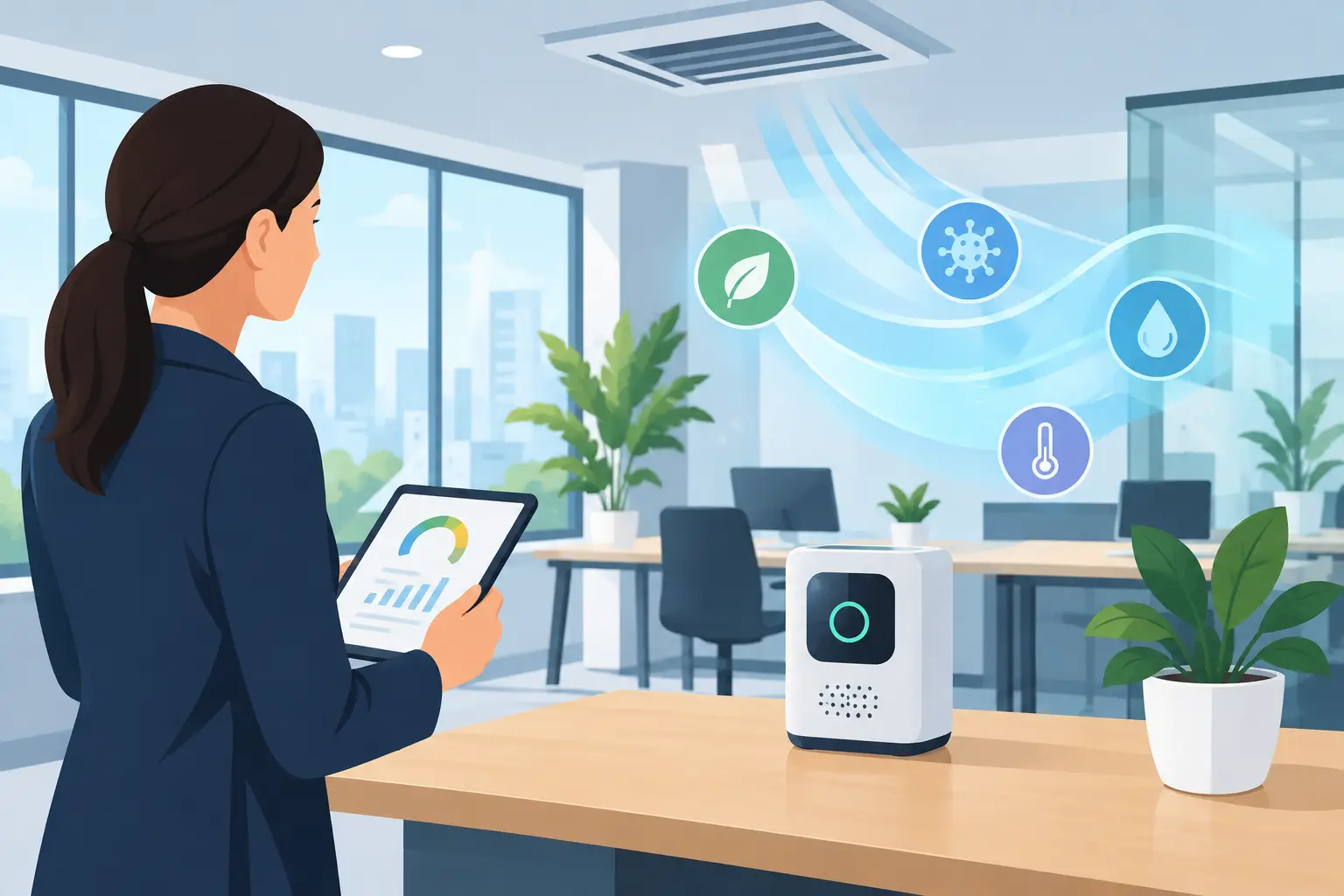
A meeting room that feels stuffy by mid-morning, persistent odours near a pantry, repeated occupant complaints, or visible dust around supply grilles are not issues to dismiss as normal building conditions. An indoor air quality IAQ assessment provides a structured way to investigate what occupants are experiencing, identify likely contributing factors, and decide what practical action is justified.
For building owners, facility managers and property management teams, the value is not simply a set of readings. A well-planned assessment turns concerns about comfort, ventilation and airborne contaminants into evidence that can support maintenance decisions, tenant communication and improvement planning.
What is an indoor air quality IAQ assessment?
An IAQ assessment examines indoor environmental conditions that can affect comfort, perceived air freshness and the suitability of a space for its occupants. The scope depends on the building, reported concerns, occupancy patterns and HVAC arrangement. It may include a walkthrough inspection, discussions with building representatives, physical measurements and a review of relevant maintenance records.
Common areas for assessment include carbon dioxide levels, temperature, relative humidity, airborne particulate matter, carbon monoxide where combustion sources may be relevant, and indicators of ventilation performance. Depending on the concern, an assessment may also consider total volatile organic compounds, formaldehyde, microbiological conditions, odours, water damage or visible mould.
These measurements need interpretation. A reading taken at one location and time is a snapshot, not a complete diagnosis of a building. An experienced assessor considers the room use, number of occupants, outdoor conditions, operating schedule, nearby activities and HVAC system condition before drawing conclusions.
When should a building arrange an IAQ assessment?
Many assessments begin after complaints, but a reactive approach is not the only reason to investigate. An assessment can be useful before a tenant handover, after refurbishment, during a ventilation upgrade, or when a facility team needs evidence to prioritise maintenance work.
It is particularly sensible to arrange an assessment when complaints are recurring or concentrated in a particular zone. Examples include headaches or discomfort reported only in one office area, musty smells after rainfall, complaints from staff seated near an air-conditioning diffuser, or discomfort in meeting rooms with high occupancy.
Other practical triggers include a history of water leakage, recent painting or installation of new furnishings, visible dust discharge from grilles, changes to occupancy, altered operating hours, or a rise in complaints after air-conditioning modifications. In kitchens, workshops, laboratories and industrial facilities, process activities and local exhaust arrangements may require closer attention.
The aim is not to assume that every complaint has a single air-quality cause. Occupant comfort can be influenced by temperature, humidity, lighting, noise, workload and individual sensitivity. A proper assessment helps separate observations from assumptions.
What happens during an IAQ assessment?
1. Understanding the concern and the building
The work should start before any instrument is switched on. The assessor needs to understand what occupants have noticed, when it occurs, which rooms are affected and whether there have been recent changes to the building or its operation.
For example, a stuffy afternoon meeting room may point towards high occupancy and insufficient outdoor air during peak use. A musty odour in the morning may relate to moisture, stagnant condensate, damp materials or an HVAC system that is not operating as intended before occupants arrive. These situations need different lines of investigation.
Useful information includes floor plans, air-conditioning and ventilation layouts, maintenance history, filter replacement records, operating schedules, renovation details and any previous complaint logs. Even incomplete records can help focus the site inspection.
2. Inspecting the occupied space and HVAC system
A site walkthrough looks for conditions that measurements alone may miss. This can include blocked or closed supply grilles, damaged ceiling tiles, staining from water leaks, poor housekeeping around return-air openings, overloaded rooms, odour sources, inappropriate storage, and signs of condensation.
The HVAC inspection may consider accessible air-handling equipment, filters, drain pans, condensate drainage, ductwork condition, outdoor air intake locations and exhaust arrangements. For commercial buildings, it is also important to consider whether the system is operating according to the intended schedule and whether different zones are receiving suitable airflow.
A dusty grille does not automatically prove that the entire duct system is contaminated, just as an occupant complaint does not automatically prove a ventilation failure. Inspection findings should guide the next step rather than become a premature diagnosis.
3. Taking measurements at meaningful locations
Sampling locations should reflect how a space is actually used. An assessment may include occupied workstations, meeting rooms, reception areas, classrooms, retail spaces or other areas where concerns have been reported. Outdoor reference readings may also be useful, particularly when haze, traffic emissions or nearby activities could influence indoor conditions.
Timing matters. A room tested while empty may appear acceptable but perform differently when occupied by twenty people. Likewise, readings can vary between the start and end of a working day, during rain, or when air-conditioning systems cycle on and off.
Carbon dioxide is often measured as an indicator linked to occupancy and outdoor-air delivery. It should not be treated as a complete measure of air quality or as proof of a particular health outcome. Particulate readings can be affected by outdoor air, cleaning work, construction dust, printing, cooking and occupant movement. The interpretation must account for these conditions.
4. Reviewing findings and recommending proportionate action
The report should clearly distinguish between measured conditions, observed site issues and recommendations. It should explain where readings were taken, when testing was carried out, the equipment or methods used, and any limitations that could affect interpretation.
Recommendations should be practical and prioritised. Some findings may call for immediate housekeeping or maintenance action, while others may need further investigation. A building with uneven room temperatures, for instance, may benefit from air balancing. Evidence of dust or debris within accessible ductwork may support a robotic duct inspection and cleaning plan. Moisture concerns may require leak rectification before any cleaning work can provide a lasting result.
Common findings and what they may mean
High humidity can contribute to a clammy feeling, condensation and conditions that support mould growth if moisture problems are present. In Malaysia’s humid climate, controlling indoor humidity often depends on correct air-conditioning operation, suitable run times, clean coils, effective condensate drainage and avoiding excessive untreated outdoor air entering the space.
Elevated particles can result from outdoor infiltration, nearby renovation work, dirty filters, poor cleaning practices or indoor activities. The right response depends on the source. Replacing filters without addressing construction dust or an unsealed opening may offer only temporary improvement.
Poorly distributed airflow can leave one area cold while another feels warm and stale. This is not always an air-cleanliness issue. It may relate to damper settings, diffuser performance, fan operation, poorly balanced branches or changes made to room layouts. Air balancing can help establish whether airflow is reaching each zone as intended.
Persistent odours need careful investigation. They may originate from drains, food preparation, waste storage, cleaning chemicals, furnishings, mould-affected materials, vehicle exhaust or process emissions. Masking an odour with fragrance is not a corrective measure. Identifying and controlling the source is more useful.
What an assessment cannot do on its own
An IAQ assessment is a decision-making tool, not an automatic repair. Testing can identify patterns and concerns, but rectification may involve several parties: the building owner, facilities team, tenant, renovation contractor, cleaning provider or specialist HVAC contractor.
It also cannot guarantee that a building will be free of every pollutant at all times. Indoor conditions change with weather, occupancy and activities. The practical objective is to identify controllable issues, maintain HVAC systems properly and create an environment that is more comfortable and better managed for occupants.
For this reason, repeat testing can be valuable after significant corrective work. It provides an opportunity to check whether ventilation, humidity control or particulate conditions have improved under comparable operating conditions.
Turning results into a maintenance plan
The strongest outcome from an indoor air quality IAQ assessment is a clear maintenance plan rather than a report that sits in a folder. Start with actions that address clear defects or sources, such as water leaks, damaged filters, drainage issues, blocked grilles or inappropriate chemical storage. Then consider system-level work where findings indicate a need, including air balancing, coil and equipment servicing, ventilation adjustments or duct cleaning.
Keep a record of complaints, inspection dates, corrective work and follow-up observations. Over time, this helps facility teams spot recurring issues and explain decisions to management or tenants with greater confidence.
If your building has recurring comfort or air-quality concerns, arranging a professional assessment is a practical first step. Aircond Clinic can help building teams investigate conditions, understand the findings and plan evidence-based HVAC or IAQ improvements. Fresh indoor air starts with knowing what is happening in the space people use every day.
Leave a Reply