
A Complete Guide for Buildings in Malaysia
Robotic duct cleaning is a method of cleaning the internal surfaces of an air conditioning and ventilation duct system using remotely operated robotic equipment. Depending on the system, the equipment may include inspection cameras, mechanical brushes and vacuum extraction to remove accumulated dust, debris and other contaminants from inside the ductwork.
For commercial buildings in Kuala Lumpur and throughout Malaysia, robotic duct cleaning offers a practical way to inspect and clean accessible sections of concealed HVAC ductwork without dismantling extensive portions of the system.
At Aircond Clinic, operated by 363 Khalifah Solution Sdn Bhd, we provide air conditioning, robotic duct cleaning and indoor air quality services for residential, commercial and industrial environments.
In this guide, we explain how robotic duct cleaning works, when it may be necessary, its benefits and limitations, and what building owners should consider before appointing a contractor.
What Is Robotic Duct Cleaning?
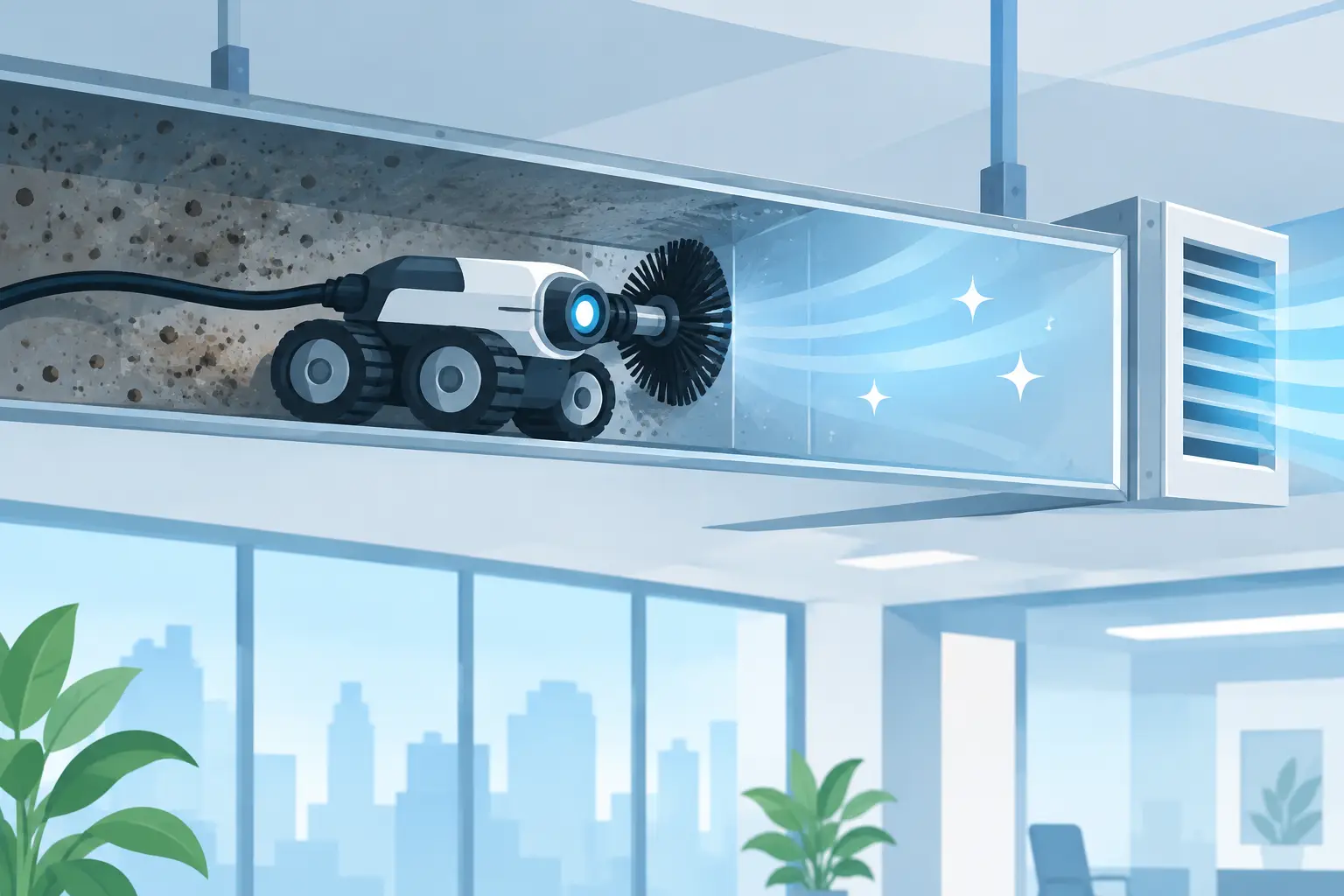
Robotic duct cleaning is a specialised HVAC maintenance process in which a remotely controlled robot is deployed inside an air duct to help remove accumulated contaminants from its internal surfaces.
The robot can be equipped with a camera to allow technicians to observe the condition of the ductwork. Depending on the equipment and cleaning method, mechanical brushes or other cleaning attachments can loosen deposits while a connected or separate vacuum system collects the dislodged material.
This approach is particularly useful for commercial buildings where air conditioning ducts are concealed above ceilings or distributed across extensive areas.
Typical applications include:
- Office buildings and commercial premises
- Shopping malls and retail outlets
- Hotels and hospitality facilities
- Hospitals and healthcare facilities
- Factories and industrial buildings
- Educational institutions
- Government buildings
- Restaurants and food-service premises, where the duct system and cleaning method are suitable
The suitability of robotic duct cleaning depends on the duct dimensions, configuration, accessibility, construction materials and condition. An initial inspection helps determine the appropriate cleaning method.
How Does Robotic Duct Cleaning Work?
A professional robotic duct cleaning project generally involves several stages. The exact procedure depends on the HVAC system, site conditions and the scope of work.
1. Preliminary Site Inspection
Before cleaning begins, the contractor reviews the HVAC system and identifies the duct sections requiring inspection or cleaning.
This stage may involve reviewing available duct drawings, identifying access points, checking the duct layout and assessing the type of duct material.
The purpose is to determine whether robotic equipment can safely access the relevant sections and whether any special precautions are necessary.
2. Pre-Cleaning Robotic Inspection
A robotic unit equipped with a camera is introduced into accessible sections of the ductwork.
The camera provides a view of internal surfaces and may reveal:
- Accumulated dust and loose debris
- Foreign objects or obstructions
- Deteriorated internal insulation
- Damaged duct surfaces or joints
- Areas requiring closer inspection or cleaning
Recorded footage can help document the condition of the ductwork before work begins.
It is important to distinguish visual observations from laboratory-confirmed findings. For example, suspected mould seen during an inspection should not automatically be treated as confirmed microbial contamination.
3. Robotic Cleaning and Contaminant Removal
Once the cleaning requirements have been established, suitable robotic equipment is deployed into the ductwork.
Depending on the system, mechanical brushes or other attachments loosen accumulated deposits from internal surfaces. A suitable vacuum extraction system collects the dislodged dust and debris.
Effective contaminant collection is essential. Simply dislodging dust without controlling its removal may allow particles to spread into other parts of the HVAC system or occupied areas.
The cleaning approach must also be suitable for the duct material. Delicate internal insulation or fibre-lined ductwork may require specially selected tools and controlled cleaning techniques to avoid damage.
4. Post-Cleaning Inspection
After cleaning, technicians can conduct another internal camera inspection of accessible sections.
Comparing pre-cleaning and post-cleaning footage helps demonstrate the visible condition of the inspected duct surfaces and identify areas that may require additional attention.
This visual verification is an important part of a documented robotic duct cleaning service.
However, camera footage alone does not establish that every part of a large duct network is clean or that indoor air quality complies with a particular standard. The coverage of the inspection and any additional testing should be stated clearly in the report.
5. Reporting and Recommendations
Depending on the agreed scope, the contractor may provide:
- Pre-cleaning inspection photographs or video
- Post-cleaning inspection photographs or video
- A summary of the work performed
- Observations on duct condition
- Identification of visible obstructions or damage
- Recommendations for further inspection, repair or maintenance
A clear report helps building owners and facility managers understand the work completed and plan appropriate follow-up actions.
What Are the Benefits of Robotic Duct Cleaning?
1. Visual Access to Concealed Ductwork
Many commercial HVAC ducts are installed above ceilings or inside building structures. Their internal condition cannot be assessed adequately by looking at the external duct surfaces alone.
A robotic inspection camera can provide visual access to suitable sections of ductwork and help technicians identify areas requiring attention.
2. Targeted Cleaning
Pre-cleaning inspection helps identify where dust, debris or other visible deposits have accumulated.
This information allows the contractor to plan cleaning activities according to the observed condition rather than relying solely on assumptions about the entire duct system.
3. Documentation of Work
Pre-cleaning and post-cleaning footage provides a visual record of the inspected sections.
This can be useful for facility managers, building owners, property management companies and maintenance teams that need documentation for maintenance records or contractor evaluation.
4. Access to Suitable Internal Duct Sections
Robotic equipment can enter certain duct sections that would otherwise be difficult for technicians to inspect directly.
Its ability to reach a particular section depends on the robot’s dimensions, the duct layout, access openings, bends, obstructions and operating conditions.
Robotic equipment does not eliminate the need for access planning or other cleaning methods where necessary.
5. Support for HVAC Hygiene Maintenance
Accumulated dust and debris can become a maintenance concern, particularly where contamination is substantial or where moisture, damaged insulation or other problems are present.
Removing deposits when cleaning is justified can support HVAC hygiene management. However, duct cleaning is only one part of maintaining an HVAC system and should be considered alongside filter maintenance, coil cleaning, moisture control and appropriate ventilation.
Important: Robotic duct cleaning does not automatically resolve every indoor air quality problem. The underlying cause must be investigated when occupants experience persistent odours, discomfort or other concerns.
What Is the Difference Between Robotic Duct Cleaning and Conventional Duct Cleaning?
Both robotic and conventional methods aim to remove accumulated contaminants from ductwork. The main difference is the equipment and method used to access, inspect and clean the internal surfaces.
| Feature | Robotic duct cleaning | Conventional duct cleaning |
|---|---|---|
| Internal inspection | Can use a camera mounted on a robotic unit | May use separate cameras, access openings or other inspection methods |
| Cleaning equipment | Remotely operated robot with suitable cleaning attachments | May use manual brushes, air tools, mechanical brushes or other specialised equipment |
| Access | Depends on robot size, duct geometry and access openings | Depends on tool reach, access openings and duct configuration |
| Visual documentation | Camera footage can document accessible sections | Documentation depends on the inspection equipment and procedure used |
| Suitable applications | Selected commercial and industrial duct systems | A wide range of duct systems, depending on the method |
| Limitations | May struggle with tight bends, obstructions, unsuitable dimensions or delicate materials | May also have access and reach limitations, depending on the equipment |
Neither method is automatically superior for every project. The most appropriate approach depends on the duct condition, construction, accessibility, contamination and required level of documentation.
For complex commercial HVAC systems, a combination of inspection and suitable cleaning techniques may be necessary.
When Should a Building Consider Robotic Duct Cleaning?
Not every HVAC duct system needs cleaning at fixed intervals. The decision should be based on the system’s condition, operational history and maintenance requirements.
Robotic duct inspection or cleaning may be worth considering when:
- A building has undergone renovation or construction work that may have introduced dust into the HVAC system.
- Visible deposits or debris have been identified inside the ductwork.
- There are suspected obstructions or damaged internal duct components.
- The facility team needs visual documentation of internal duct conditions.
- A maintenance programme requires verification of previously completed cleaning.
- There are recurring concerns that may warrant investigation of the HVAC system.
Persistent odours, poor airflow or occupant complaints do not necessarily mean that dirty ducts are the cause. Other possible causes include dirty filters, cooling-coil problems, incorrect damper positions, inadequate outdoor air, moisture issues or equipment faults.
A proper inspection helps determine whether duct cleaning is appropriate or whether another corrective action is needed.
Is Robotic Duct Cleaning Necessary for Every Commercial Building?
No. Robotic duct cleaning should not be treated as a mandatory service for every building regardless of condition.
Some duct systems may have little visible contamination and may not require cleaning. In other cases, inspection may reveal substantial deposits, construction debris, damaged insulation or other conditions that justify corrective work.
The most practical approach is to assess the system before recommending a cleaning scope.
Building owners should ask the contractor to explain the observed condition, show relevant inspection evidence where available and identify the specific areas included in the proposed work.
This helps avoid unnecessary cleaning and ensures that the work addresses an identified maintenance need.
Does Robotic Duct Cleaning Improve Indoor Air Quality?
Robotic duct cleaning can remove accumulated dust and debris from the internal surfaces of ductwork. This may help reduce a source of particulate contamination when the deposits are significant and the cleaning is carried out correctly.
However, cleaning the ducts alone does not guarantee improved indoor air quality.
Indoor air quality can be affected by many factors, including:
- Outdoor air entering the building
- Ventilation rates and air distribution
- Air filtration
- Moisture and condensation
- Indoor activities and pollutant sources
- HVAC equipment condition
- Contamination in other system components
Where indoor air quality is a concern, duct inspection and cleaning may form part of a broader assessment. Depending on the situation, additional measurements or investigations may be required.
Aircond Clinic provides IAQ assessment services for clients who need a more comprehensive evaluation of indoor environmental conditions.
What Should You Look for When Choosing a Robotic Duct Cleaning Contractor in Malaysia?
Selecting a suitable contractor involves more than comparing quotations.
Before appointing a robotic duct cleaning provider, consider the following.
1. Relevant experience
Ask whether the contractor has experience with buildings and duct systems similar to yours.
2. Suitable equipment
Confirm that the equipment is appropriate for the duct dimensions, configuration and construction materials.
3. Pre-cleaning inspection
Ask how the contractor establishes the existing condition and determines which sections require cleaning.
4. Contaminant collection
Understand how dust and debris will be captured and removed during the cleaning process.
5. Protection of duct materials
Ask how the cleaning method will protect internal insulation, duct liners, joints and other components.
6. Post-cleaning verification
Confirm whether internal camera footage or other suitable evidence will be provided to document the completed work.
7. Clear scope and reporting
The quotation should identify the duct sections covered, the proposed method, access requirements, exclusions and deliverables.
8. Appropriate treatment of suspected mould
If suspected mould or other microbial contamination is observed, ask how the finding will be assessed and what additional investigation or treatment, if any, is justified. Chemical disinfection should not be assumed to be necessary for every duct cleaning project.
A professional contractor should explain the proposed method and its limitations clearly.
Robotic Duct Cleaning Services in Kuala Lumpur and Malaysia
Aircond Clinic, operated by 363 Khalifah Solution Sdn Bhd, provides air conditioning and specialist HVAC services, including robotic duct cleaning and indoor air quality assessment.
Robotic duct cleaning can help building owners and facility managers investigate the condition of concealed ductwork, remove accumulated deposits where justified and document the visible condition of inspected sections.
Our approach is to consider the building’s requirements, duct configuration, access conditions and observed contamination before determining the appropriate scope of work.
Whether you manage an office, commercial property, educational facility, industrial building or other premises, the first step is to understand the condition of the HVAC duct system and identify the maintenance work required.
Looking for robotic duct cleaning in Kuala Lumpur or Selangor?
Contact Aircond Clinic to discuss your building, arrange an inspection where appropriate and request a quotation.
- Company: 363 Khalifah Solution Sdn Bhd (Aircond Clinic)
- Website: https://www.aircondclinic.com/
- Phone: 019-448 9203
Aircond Clinic — the power to heal.
Frequently Asked Questions About Robotic Duct Cleaning
1. What is robotic duct cleaning?
Robotic duct cleaning uses remotely operated equipment to help inspect and clean the internal surfaces of HVAC ductwork. Depending on the equipment, the robot may use a camera and mechanical cleaning attachments, supported by a suitable vacuum extraction system.
2. How does a robotic duct cleaning robot work?
The robot is inserted into an accessible section of ductwork and controlled by a technician. Its camera helps the technician observe internal conditions while suitable cleaning attachments loosen deposits. Vacuum extraction is used to collect the dislodged material.
3. Is robotic duct cleaning suitable for offices and commercial buildings?
It can be suitable for many commercial and industrial duct systems. Suitability depends on duct dimensions, layout, access, construction materials and condition. A preliminary assessment helps determine whether robotic cleaning is appropriate.
4. How much does robotic duct cleaning cost in Malaysia?
The cost depends on the total duct area, contamination level, duct configuration, access requirements, site conditions, equipment and reporting requirements. The contractor should assess the project scope before providing a quotation.
5. How often should air ducts be cleaned?
There is no single cleaning interval that is appropriate for every building. The need for cleaning depends on inspection findings, building activities, maintenance history, contamination and applicable requirements. Inspection and condition-based maintenance can help determine when cleaning is justified.
6. Can robotic duct cleaning remove mould?
Robotic cleaning may remove certain deposits from accessible duct surfaces, but visible suspected mould requires appropriate assessment. The underlying moisture source must also be addressed. Cleaning alone will not resolve a continuing moisture problem, and visual inspection cannot confirm the identity of a microorganism.
7. Does robotic duct cleaning improve airflow?
Removing substantial deposits or obstructions may help address some restrictions within ductwork. However, low airflow can also result from dirty filters, closed dampers, duct damage, fan problems or system design issues. Airflow should be investigated rather than assuming that duct cleaning will resolve the problem.
8. Is robotic duct inspection the same as robotic duct cleaning?
No. Robotic duct inspection uses equipment such as internal cameras to assess duct conditions. Robotic duct cleaning involves removing accumulated deposits using suitable cleaning equipment and contaminant collection methods. Inspection may be performed before and after cleaning, but inspection alone does not clean the ductwork.
9. Will robotic duct cleaning eliminate all indoor air quality problems?
No. Indoor air quality depends on ventilation, filtration, moisture control, pollutant sources and HVAC system performance, among other factors. Duct cleaning may address one source of contamination but cannot guarantee that all indoor air quality issues will be resolved.
10. How can I request robotic duct cleaning in Kuala Lumpur?
Contact Aircond Clinic through its website at
https://www.aircondclinic.com/ or
call 019-448 9203.
Provide your building type, approximate duct area, location and any known concerns so the requirements can be discussed.
Conclusion
Robotic duct cleaning is a specialised method of inspecting and removing accumulated deposits from suitable HVAC duct systems. Its value lies in combining appropriate cleaning techniques with access to concealed duct sections and, where available, visual documentation of the work.
For building owners and facility managers, the right decision starts with understanding the actual condition of the ductwork, selecting a suitable cleaning method and verifying the work performed.
Aircond Clinic provides robotic duct cleaning and IAQ-related services in Kuala Lumpur and surrounding areas, helping clients make informed decisions about HVAC maintenance and duct hygiene.
-
Robotic Air Duct Cleaning for Better Building Air
Robotic air duct cleaning helps Malaysian facilities inspect and remove dust in concealed ductwork, supporting…
-

What Does Indoor Air Quality Test For in Buildings?
What does indoor air quality test for? Learn which pollutants, comfort conditions and ventilation factors…
-

How Can I Check My Indoor Air Quality at Work?
How can I check my indoor air quality? Practical monitoring and professional assessment help create…
Leave a Reply