
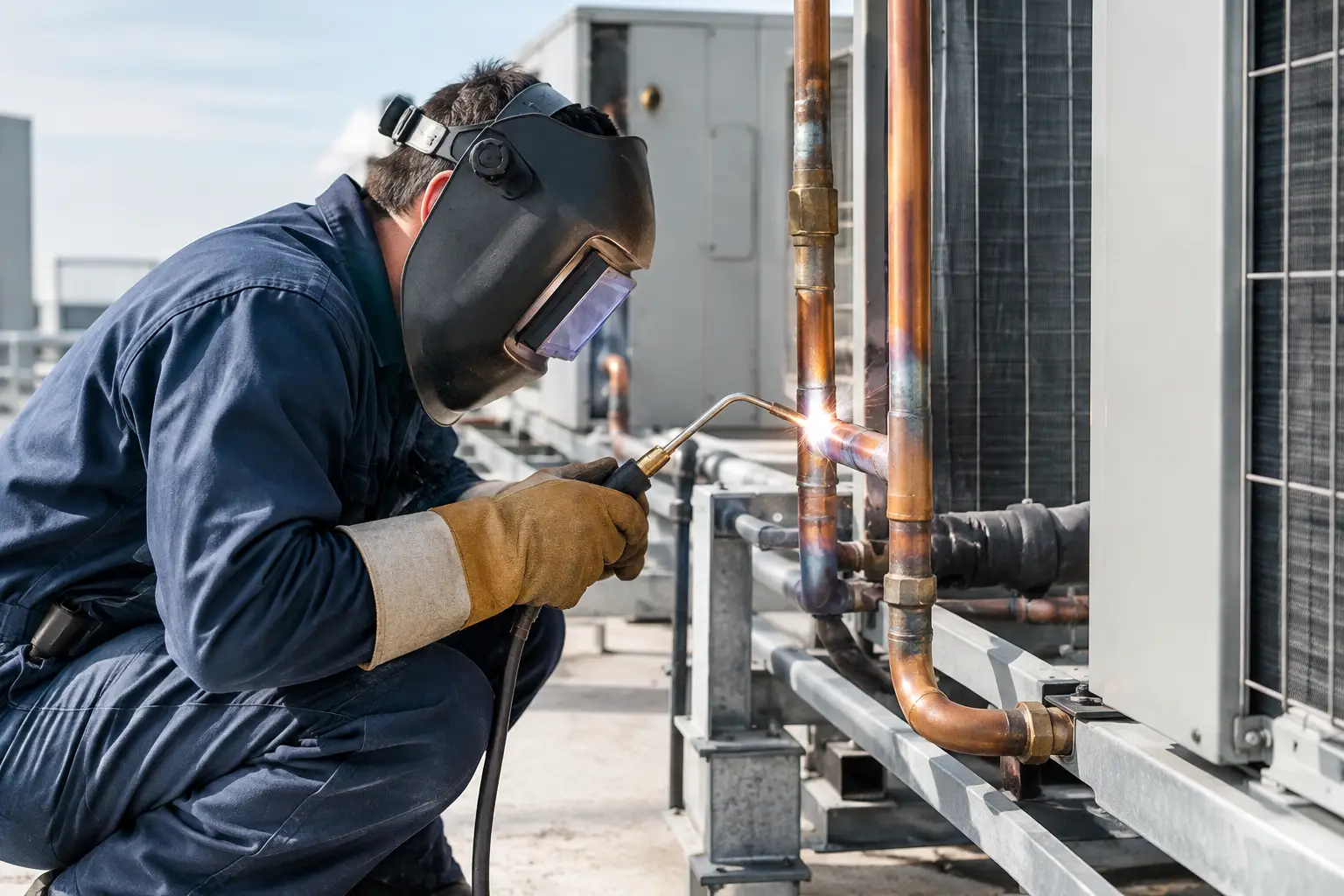
Industrial welding works rarely stay contained within the work zone. Welding fumes, grinding dust, heat and airborne metal particles can move through open spaces, return-air grilles and temporary ventilation paths. For facility managers, the issue is not simply completing a repair or fabrication task. It is protecting occupants, equipment and indoor environmental conditions while the work is taking place.
This is especially relevant in factories, plant rooms, warehouses, commercial kitchens and occupied commercial buildings where welding may be required for pipe supports, structural repairs, machinery modifications or ductwork alterations. Good coordination between the welding contractor, site safety team and HVAC maintenance provider helps prevent avoidable contamination, disruption and fire risk.
Why welding affects building air systems
Welding produces a complex mix of gases and fine particulate matter. The exact emissions depend on the welding process, base metal, filler material, coatings and work conditions. Grinding, cutting and surface preparation can add further dust to the environment.
In an open industrial area with suitable extraction, these contaminants may disperse more readily. In enclosed or partly enclosed spaces, however, they can remain suspended and travel beyond the work area. An operating air conditioning or mechanical ventilation system may draw contaminants towards return-air intakes and distribute them to other zones.
The result depends on the building layout and the system design. A small welding job near an isolated external opening presents different considerations from repeated hot works beside a return-air riser serving offices, control rooms or production areas. Facilities should therefore assess the location and HVAC arrangement before work begins rather than relying on a standard response.
Common HVAC concerns during hot works
The first concern is recirculation. If air-handling units continue operating normally near the welding location, fumes can enter return ducts and settle on filters, coils, diffusers or internal duct surfaces. Some particles may be captured by filters, but filter performance varies and standard filters are not a substitute for source control.
Heat is another practical issue. Welding and cutting can raise temperatures in confined areas, placing extra demand on nearby cooling systems. Where smoke or fumes trigger alarms, emergency responses and business interruptions can follow. There is also a fire concern when sparks reach combustible dust, grease deposits or unprotected materials near air ducts and ventilation openings.
For buildings with sensitive operations, such as food preparation areas, laboratories, clean manufacturing spaces, server rooms or healthcare-related areas, the tolerance for airborne contamination may be lower. Work methods, isolation arrangements and post-work checks should reflect that higher level of risk.
Planning industrial welding works around HVAC
A hot-work permit is an essential safety control, but it should be supported by a practical ventilation plan. Before welding begins, identify the nearest supply-air, return-air and exhaust grilles. Establish which HVAC unit serves the area and whether air can migrate to adjacent occupied spaces.
Turning off or isolating selected HVAC equipment may be appropriate during work, particularly where return air could pull fumes into ductwork. This decision should be planned carefully. Shutting down too much ventilation may worsen heat and fume build-up in the welding zone, while leaving the wrong system running may spread contaminants. The best approach depends on the source location, available local extraction, outdoor-air pathways and occupancy nearby.
Temporary barriers can help limit migration, but they must not create a poorly ventilated enclosure for welders. Local exhaust ventilation positioned close to the welding point is usually more effective than relying on general room ventilation alone. Exhaust discharge should be directed safely and should not be positioned near fresh-air intakes.
Facilities should also consider timing. Welding outside normal operating hours can reduce occupant exposure and simplify HVAC isolation. It does not remove the need for controls, particularly where duct systems, equipment rooms or overnight staff may still be affected.
A practical pre-work discussion
Before authorising the task, the responsible parties should agree on the work location, materials involved, welding method, expected duration and nearby ventilation routes. They should also confirm how the work area will be screened, how fumes will be extracted, which HVAC equipment will be adjusted, and who is authorised to restore systems afterwards.
This discussion should include the condition of nearby ducts and exhaust systems. For example, welding near kitchen extract ductwork requires particular care because grease accumulation can increase fire risk. Welding beside old or damaged duct insulation also calls for attention, as heat or disturbance may affect surrounding materials.
Protecting ducts, filters and air-handling equipment
Ductwork is often out of sight, which makes it easy to overlook during industrial maintenance. Yet open grilles and return-air paths can provide a direct route for welding residue to enter the HVAC system. Covering nearby grilles with suitable temporary protection may help during short-duration work, provided this does not interfere with required ventilation or cause equipment problems.
Where a duct section is being modified or welded, the system should be properly isolated. Open duct ends should be protected from debris. When work is complete, remove temporary protection carefully so collected dust does not fall into the duct or occupied space.
Filters deserve attention after welding, particularly if the work occurred near return-air points or if visible smoke escaped the work area. A visual inspection may identify darkened or dust-loaded filters, but it cannot confirm every concern. If there is reason to believe fumes or particulate entered the system, facility managers should assess the affected air-handling unit, filter bank and accessible duct sections before returning to normal operation.
Coils can also collect fine debris over time. Contamination on a cooling coil may restrict airflow and affect heat transfer, although the extent of any impact depends on the quantity and nature of material entering the unit. Maintenance decisions should be based on inspection findings, not assumptions.
Air quality checks after welding work
Once industrial welding works are complete, the site should not treat the removal of tools as the final step. The area needs adequate airing before regular occupancy resumes. The required period will vary according to the scale of work, local extraction performance, room volume and whether the ventilation system was operating or isolated.
A basic post-work inspection should look for visible dust, settled residue, unusual odours, damage to grilles or duct insulation, and signs that temporary barriers have failed. It is also sensible to confirm that smoke detectors, fire dampers and HVAC controls have been returned to their intended settings.
For larger works or areas with recurring complaints, an indoor air quality assessment can provide a more structured review of environmental conditions. Assessment does not automatically prove that welding is the cause of a problem, but it can help identify concerns that warrant further investigation. Airflow measurements may also be useful where altered ductwork, closed dampers or temporary system changes have affected room pressure or air distribution.
When duct cleaning may be needed
Not every welding task requires duct cleaning. A brief, well-contained job with effective source extraction and no evidence of HVAC entry may only require routine checks. Ordering cleaning without inspecting the system first can add cost without addressing the actual risk.
Cleaning becomes more relevant when there is confirmed debris entry, visible residue in accessible duct sections, repeated welding near return-air openings, or a documented incident involving smoke migration. Robotic duct inspection can be useful in larger or difficult-to-access systems because it allows the condition of internal duct surfaces to be reviewed before a cleaning scope is decided.
The same principle applies to kitchen exhaust systems. Welding near greasy extract ducts should trigger a careful fire-safety review. If grease deposits are present, cleaning and maintenance should be planned by a competent specialist before hot works proceed where possible.
Clear responsibilities reduce disruption
Industrial sites often involve several parties: building management, maintenance teams, safety officers, welding contractors, equipment suppliers and HVAC specialists. Problems arise when each assumes someone else has checked the ventilation system.
A clear work plan should state who controls HVAC isolation, who monitors the hot-work area, who inspects equipment after completion and who signs off the return to normal operation. Record any filter changes, system adjustments, cleaning activities and findings. These records support future maintenance planning and give facility managers a clearer picture when similar work is requested.
Aircond Clinic supports facilities with practical HVAC inspections, air balancing, indoor air quality assessment and specialist duct cleaning where site findings justify it. For welding-related projects, an early conversation can help ensure that ventilation controls match the real conditions on site.
Fresh, well-managed indoor air is part of a safe working environment. Before the next hot-work permit is issued, take a moment to consider where the fumes will go and whether the building’s air system is ready for the task.
Leave a Reply