
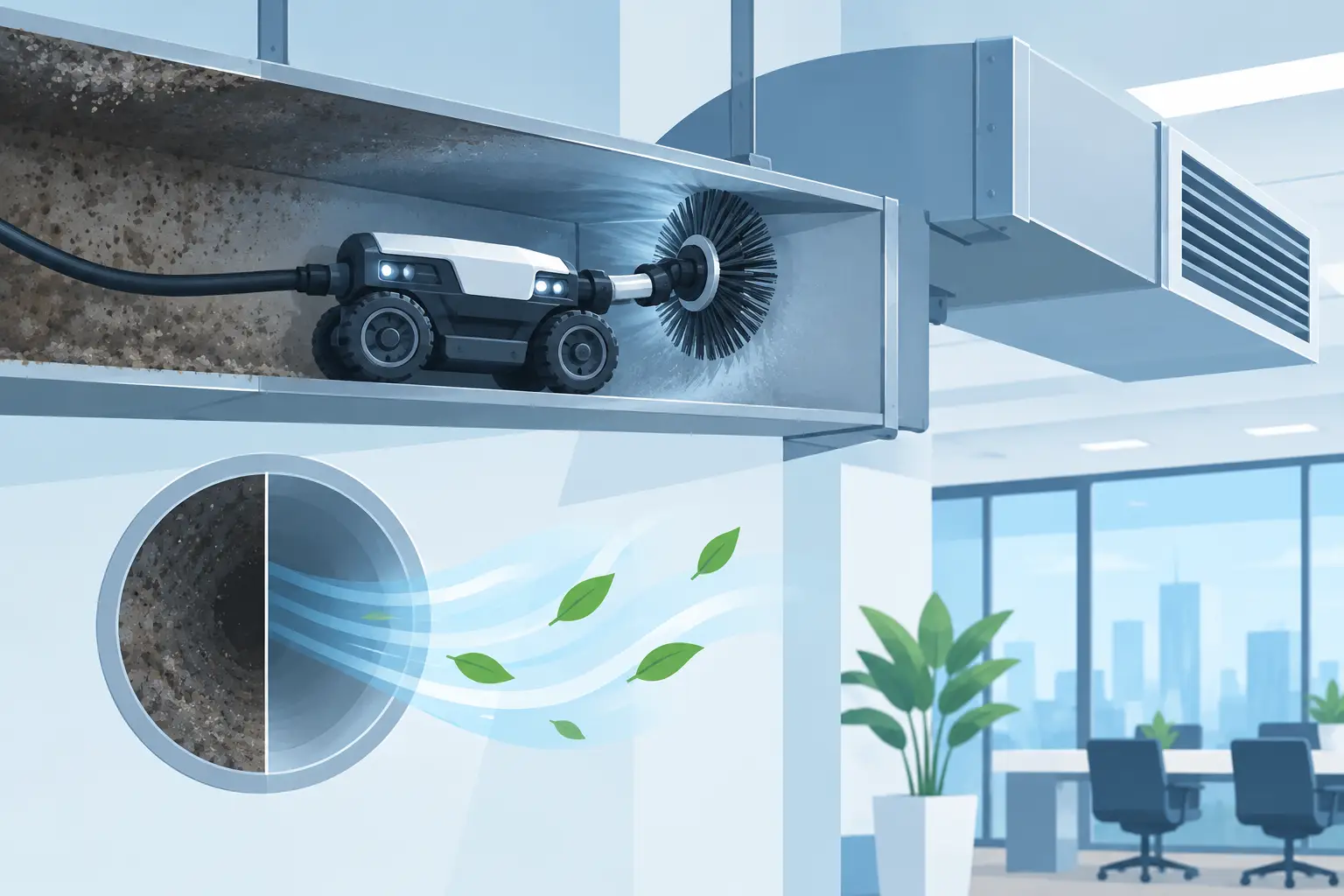
A ceiling diffuser may look clean while the ductwork behind it holds years of dust, construction residue and loose debris. Robotic duct cleaning gives facility teams a practical way to inspect these hidden areas before deciding what work is actually needed. Rather than treating every duct system as the same, it combines recorded visual evidence with targeted cleaning methods.
For building owners and managers, that evidence matters. HVAC ducts are difficult to access, particularly in occupied offices, shopping centres, hotels, factories and institutional buildings. A planned inspection can help maintenance teams understand the condition of the system, prioritise work sensibly and keep a clear record of what has been found.
What is robotic duct cleaning?
Robotic duct cleaning uses a compact, remotely operated camera unit that travels through accessible sections of HVAC ductwork. The operator views live footage while the robot documents dust build-up, loose particles, surface contamination, damaged internal lining, obstructions or other visible concerns.
Where cleaning is appropriate, specialist equipment is used to loosen and collect debris without unnecessary dismantling of the duct system. The exact method depends on the duct size, layout, material and condition. A straight galvanised steel duct may be relatively simple to inspect, while older ductwork with narrow branches, flexible connections or fragile insulation requires a more careful approach.
This is not simply a camera exercise. The value lies in using inspection findings to guide the scope of work. If a section is clean, it may not need the same level of intervention as a section serving a high-traffic area or one affected by recent renovation works.
Why duct condition deserves attention
Ductwork is part of the building’s air distribution path. Supply ducts carry conditioned air to occupied spaces, while return ducts bring air back to the air handling unit or fan coil system. When dust and debris accumulate inside, they can be disturbed by airflow and may contribute to poor housekeeping conditions around grilles and diffusers.
Duct cleanliness is only one part of indoor environmental quality. Odours, humidity, filtration performance, outdoor air supply, occupant density and maintenance of cooling coils can all influence how a space feels. It would be inaccurate to assume that duct cleaning alone will solve every complaint about stale air, discomfort or dust.
However, when inspection footage confirms visible deposits or debris, robotic cleaning can be a sensible part of a broader maintenance response. It is particularly relevant after fit-out works, ceiling repairs, water-related incidents, pest activity or long periods without documented duct inspection.
Situations that may justify an inspection
A building does not need to wait for a major complaint before checking its ductwork. Inspection is often considered when occupants repeatedly report dust near air outlets, when a refurbished area is being handed over, or when maintenance personnel notice debris during access-panel work.
It can also support maintenance planning in older properties where duct condition is unknown. For property management companies and joint management bodies, recorded footage can make it easier to explain why a particular scope of cleaning has been recommended and which areas should take priority.
How the process works in an occupied building
A professional robotic duct cleaning project begins with a site review. The contractor identifies the relevant air handling units, fan coil units, duct routes, access points and operational constraints. Building use matters. Cleaning work in a hospital, school, restaurant, office tower or production facility may need different timing, containment measures and coordination with site personnel.
The ductwork is then inspected through existing or suitably placed access openings. The camera footage helps establish the reachable areas, visible level of build-up and any conditions that may affect cleaning. Where possible, the findings should be documented before work starts.
During cleaning, debris is loosened using suitable mechanical agitation tools and controlled under negative pressure with collection equipment. This helps prevent dislodged material from moving into occupied areas or further along the duct system. Access panels are sealed after work, and the treated sections can be reinspected to provide a visual record of the completed cleaning.
For a large commercial site, work may be phased by floor, air handling unit or tenancy. This reduces disruption and allows the facilities team to maintain essential operations. In some cases, cleaning outside business hours is the more practical option, especially where ceiling access or temporary work zones are required.
What robots can and cannot do
Robotic equipment improves visibility in areas that are otherwise difficult to inspect, but it has limits. The robot can only travel where duct dimensions, bends, internal conditions and access arrangements permit. Very small ducts, severely damaged sections and complex flexible duct connections may require alternative inspection methods or partial dismantling.
A camera also records what is visible at the time of inspection. It cannot, by itself, confirm the source of an odour, prove that a building-wide IAQ issue is caused by ductwork, or assess airborne particle levels. Those questions may require an indoor air quality assessment, airflow testing, filter review or inspection of cooling coils and drain pans.
Good advice should reflect these limits. If footage shows clean ducts but occupants still experience uneven temperatures, the more relevant next step may be air balancing or investigation of damper settings, fan performance and diffuser distribution. If moisture damage is visible, the underlying water source should be addressed before cleaning is treated as a lasting solution.
Planning robotic duct cleaning effectively
The best results usually come from including duct inspection in a planned HVAC maintenance programme rather than arranging cleaning only after conditions have become obvious. There is no universal cleaning interval that suits every building. Usage, surrounding environment, renovation activity, filtration, tenant operations and the history of the HVAC system all affect the appropriate schedule.
Facility managers should keep records of inspection footage, cleaning dates, affected air handling units and any repairs identified during the work. These records support future budgeting and make it easier to compare conditions over time. They can also help when a building changes tenants, undergoes refurbishment or receives repeated indoor comfort complaints.
Before appointing a contractor, it is reasonable to ask how the ductwork will be accessed, how debris will be controlled, what evidence will be provided and whether the proposed method suits the duct material. The lowest quotation may not account for difficult access, phased working or the need to protect an occupied environment.
Robotic duct cleaning and wider HVAC care
Duct cleaning is most useful when it sits alongside the basics of HVAC care: clean filters, maintained coils, clear condensate drainage, correctly operating fans and suitable airflow distribution. Neglect in any of these areas can affect comfort and system performance, even where the ductwork has been cleaned.
For buildings with persistent air quality concerns, an IAQ assessment can add useful context. It helps separate assumptions from measured or observed conditions and gives the management team a clearer basis for deciding whether duct cleaning, ventilation adjustments, filter improvements or other corrective work should be prioritised.
Aircond Clinic approaches robotic duct cleaning as an evidence-based service, not a one-size-fits-all remedy. A clear inspection, appropriate cleaning scope and sensible follow-up can help building teams care for the parts of their HVAC system that occupants rarely see but rely on every day.
When ductwork is hidden above ceilings, documented inspection is often the most practical place to start. It gives decision-makers a clearer picture, helps avoid unnecessary work and supports fresher, more comfortable indoor spaces for the people using the building.
Leave a Reply