
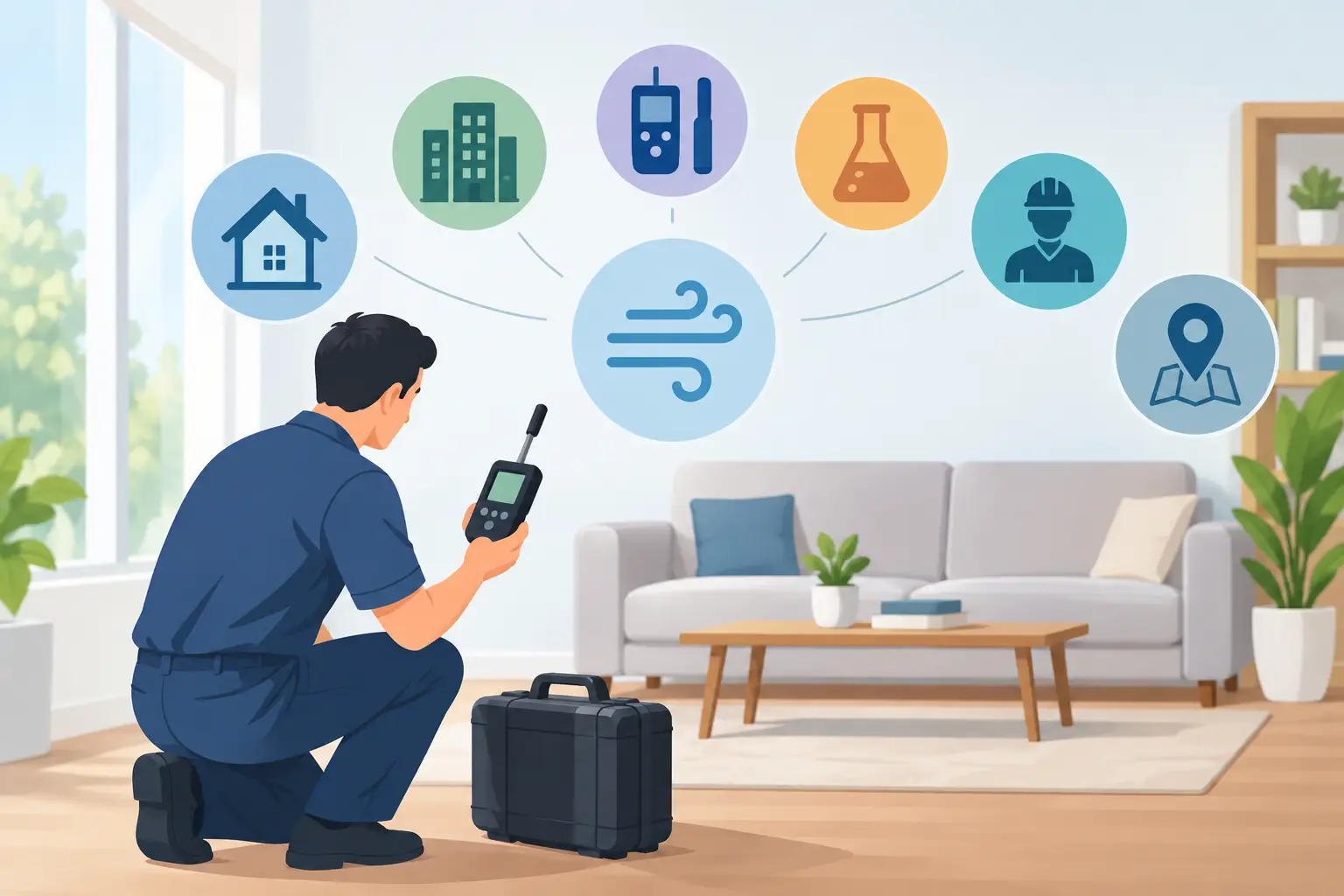
A musty meeting room, repeated occupant complaints, condensation near supply grilles, or dust returning soon after cleaning can all prompt the same question: what will this cost to investigate properly? Indoor air quality testing cost is not a fixed fee because each building has different spaces, HVAC conditions and potential sources of concern. A meaningful assessment starts with the question that needs answering, rather than a one-size-fits-all test.
For facility managers and building owners, the best value is not necessarily the lowest quotation. It is an assessment that produces clear findings, explains what they mean for the building, and helps you decide whether maintenance, ventilation adjustments, cleaning or further investigation is required.
What affects indoor air quality testing cost?
The scope of work is the main driver. A small office with a straightforward comfort complaint requires a very different approach from a multi-storey commercial building, a school, a restaurant or a manufacturing facility. Before pricing can be sensible, the assessor needs to understand the building use, the affected areas, the HVAC arrangement and the concern being reported.
Building size, layout and access
More rooms do not always mean more testing, but they often require more time for inspection and representative measurements. An assessment may need to cover occupied work areas, meeting rooms, lobbies, corridors, toilets, plant rooms, outdoor reference points and other relevant locations.
Access also matters. Testing outside normal working hours, arranging permits, entering restricted production areas, working around tenant operations or coordinating with several building representatives can increase the labour involved. In occupied premises, a good plan should minimise disruption while still collecting useful information.
The purpose of the assessment
Testing to establish a general baseline has a different cost from investigating a defined problem. For example, staff may report stuffiness in the afternoon, odours after rainfall, irritation in one department, or uneven cooling after an office refurbishment. Each situation calls for different observations and measurements.
A basic indoor environmental assessment may consider temperature, relative humidity, carbon dioxide, particulate matter and ventilation-related conditions. Where there is a specific concern, the scope may expand to include airborne particles, volatile organic compounds, carbon monoxide, mould indicators, microbiological sampling or laboratory analysis. These should not be added automatically. The right tests depend on the evidence available and the likely sources.
Number and timing of samples
Indoor air conditions change throughout the day. Occupancy, outdoor weather, air conditioning schedules, cooking activity, cleaning chemicals, production processes and open doors can all affect readings. A single spot measurement may be useful for screening, but it may not represent normal building conditions.
Testing cost can increase when the work requires repeated readings, continuous monitoring, several sampling locations or comparison between indoor and outdoor air. Timing may also be important. A complaint that occurs only after lunch, during peak occupancy or when a particular air handling unit starts should be investigated under those conditions where practical.
Equipment, laboratory work and reporting
Professional instruments require calibration, careful use and a suitable measurement method. Some investigations also require specialist sample media, controlled handling, laboratory analysis and documented chain of custody. These elements affect the quotation, particularly where results need to support a formal building decision, tenant discussion or remedial work plan.
The report is another important part of the service. A low-cost visit with a few readings may have limited value if no context is provided. A useful report should record where and when measurements were taken, the relevant site observations, any limitations, the findings and practical recommendations. It should distinguish measured conditions from possible causes that need further confirmation.
What a useful IAQ assessment should include
An indoor air quality assessment is more than placing a metre in a room. The work should begin with a walkthrough of the affected areas and a discussion of the building history. Recent refurbishment, water leaks, changes in occupancy, cleaning practices, complaints, air conditioning maintenance records and operating hours can all provide useful clues.
The assessor should then review the HVAC system as part of the indoor environment. Dirty filters, poor outside-air intake conditions, blocked grilles, damaged insulation, poorly maintained drain pans, unbalanced airflow and neglected ductwork may contribute to comfort or cleanliness concerns. However, no single observation should be treated as proof of the whole problem without appropriate evidence.
Carbon dioxide is often measured in offices and classrooms as an indicator of occupancy and ventilation conditions. It is not a complete measure of indoor air quality, nor does one result diagnose every complaint. Likewise, visible dust does not automatically confirm contamination inside ducts, and an odour does not always identify its source. Good assessment work connects readings with site conditions, building use and HVAC performance.
Low-cost testing versus a focused investigation
A low-cost test can be suitable when the objective is simple, such as obtaining a general snapshot of an occupied room. It may be less suitable when complaints are persistent, affect several occupants, occur at certain times, or could be linked to ventilation, moisture or a process within the building.
The trade-off is clear: a narrow scope costs less initially but can leave important questions unanswered. A broad investigation gathers more evidence but may include measurements that do not change the final action. The most practical approach is usually a focused first stage. This identifies whether the concern is likely to relate to HVAC operation, ventilation, moisture, housekeeping, external pollution or another source, then recommends further testing only where justified.
For example, an office experiencing stale air may benefit first from an inspection of fresh-air provision, operating schedules, filter condition and airflow distribution. A site with recurring damp patches and persistent odours may require a more detailed moisture and mould-related investigation. Testing should follow the problem, not the other way around.
Budgeting for an IAQ assessment in Malaysia
Rather than relying on a generic online price, request a quotation based on your actual site conditions. Provide enough information for the service provider to propose a proportionate scope. This helps avoid comparing a basic reading service with a comprehensive assessment that includes inspection, monitoring, documentation and recommendations.
When requesting a quotation, it is helpful to state:
- the building type, approximate floor area and number of affected spaces;
- the nature, location and timing of the concern;
- the number of occupants and typical operating hours;
- details of the air conditioning and ventilation system, if known; and
- whether you need a general assessment, an investigation of a complaint, or evidence for maintenance planning.
Ask what parameters will be measured, how many locations are included, whether laboratory analysis is proposed, and what the final report will contain. If quotations differ significantly, compare the scope line by line. The cheapest option may exclude the site inspection or practical recommendations that make the results useful.
When should testing be prioritised?
Arrange an assessment promptly when complaints are recurring, spread across an occupied area, or coincide with a known building issue such as water ingress, HVAC breakdowns or renovation work. It is also sensible to investigate before major duct cleaning, air balancing or ventilation upgrades, so that remedial work is based on observed conditions rather than assumptions.
Where there is a suspected immediate safety issue, such as combustion fumes, chemical release or a strong unexplained odour causing acute discomfort, follow your site safety procedures first. Isolate the affected area where appropriate and seek the relevant competent assistance. IAQ assessment supports informed building decisions, but urgent hazards require immediate control measures.
For planned maintenance, an assessment can give facility teams a clearer basis for prioritising work. Aircond Clinic can help building teams define a practical IAQ assessment scope that considers the spaces, occupants and HVAC system involved. A clear quotation should leave you knowing what will be tested, why it is relevant, and what decisions the findings can support. That is the point at which testing becomes a useful investment in a fresher, more comfortable indoor environment.
Leave a Reply